This Cottagecore Handmade Mug Ideas list is tailored for the hands-on creator, blending the whimsical charm of Mushrooms and Frogs into tangible handmade mug ideas.
Are you looking for a weekend project that brings a little woodland magic to your morning coffee? Great! We’re skipping the generic and delivering ten genuinely achievable designs that will boost your handmade mugs collection.
1. The Gilled Amanita Base Mug
You know how most handmade mugs just slap a design on the side? We’re starting from the base up.
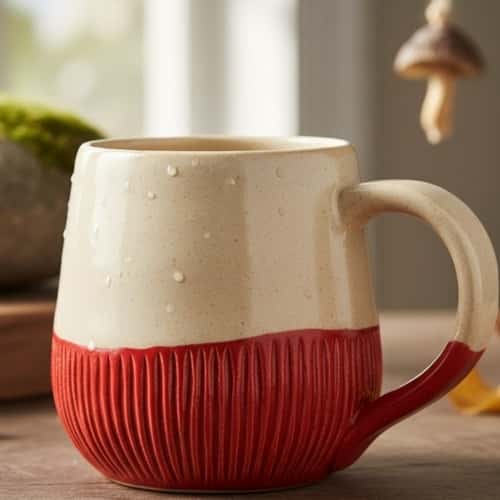
This design focuses on a detailed mushroom cap that actually forms the bottom section of your mug, giving it a cool, slightly wobbly yet stable look. How is this done? Start by throwing a wider base than usual on the wheel, or if you’re hand-building, create a slightly flared cylinder.
The unique twist comes in carving the gills – those little ridges underneath a mushroom cap – into the bottom-most flare of the mug before the clay hardens.
You can use a small loop tool for this, dragging it from the base up towards the center in a radiating pattern.
Then, when you’re glazing, paint the main body of the mug a creamy off-white, and the carved base section a bright Amanita red or deep burnt orange.
Use a thin, darker wash over the carved gills to make those lines really pop, giving the entire piece a sturdy, earthbound feeling.
This elevates the standard cylindrical form, and is a fantastic technique for unique DIY Handmade Mugs. It makes for a great conversation starter, don’t you think?
2. The Sleeping Frog Lily Pad Handle
Let’s tackle the handle, which is often the most boring part of a mug. Forget the standard loop; we’re going for functional art.
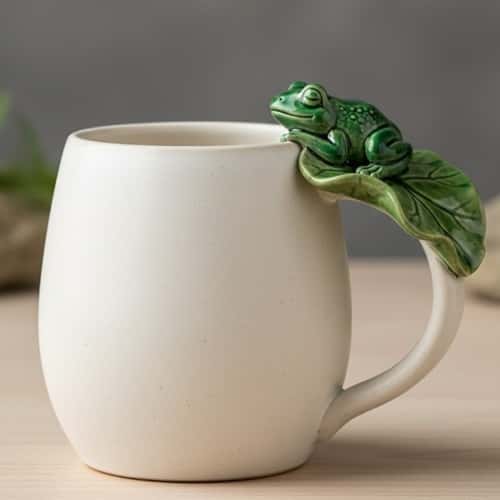
This Cottagecore Handmade Mug design uses a little frog as the focal point of the handle itself, turning a utility into a whimsical scene.
You need to sculpt a small, round frog shape, keeping it fairly simple and robust – no delicate limbs that will snap off.
Attach the frog to the body of the mug, about two-thirds of the way up.
Below the frog, attach a flat, slightly curved piece of clay, shaped like a small lily pad or a wide, rounded leaf, which serves as the actual grip for your fingers.
The frog is resting its chin or front legs on the lip of this leaf, looking like it’s taking a nap.
Glaze the frog a deep emerald green, the lily pad a mossy, light green, and maybe add a little texture with a sponge to the frog’s back before firing to give it that bumpy, warty feel.
This design provides a wide, comfortable grip, proving that handmade creations can be both beautiful and ergonomic.
3. Faux-Bark Texture with Peeking Polypores

How about bringing the actual texture of the forest to your ceramic? That’s where the faux-bark technique comes in, giving your mug a rugged, natural feel.
Before the clay is bone dry, use a combination of tools – a wire brush, a stiff toothbrush, and maybe a dull needle – to scrape, gouge, and etch the exterior surface of the mug to resemble the rugged, cracked look of tree bark.
Don’t be too neat; nature isn’t! The unique detail is the polypore mushrooms (those shelf-like fungi).
Sculpt three or four very small, fan-shaped shelves and attach them subtly to the side of the mug, near the top rim or the base, making them look like they are growing straight out of the bark.
Glaze the entire mug in a deep, mottled brown and black glaze to mimic aged wood.
Then, use a pale beige or white glaze just on the polypore caps, allowing the texture of the clay to show through a bit.
This creates a very textured, rustic piece that fits perfectly within the core theme of Cottagecore Handmade Mug Ideas. It’s more sophisticated than just a painted scene, wouldn’t you agree?
4. Mushroom Cap Inset Bottom
This is another great way to use the form itself for your design, moving beyond simple surface decoration.
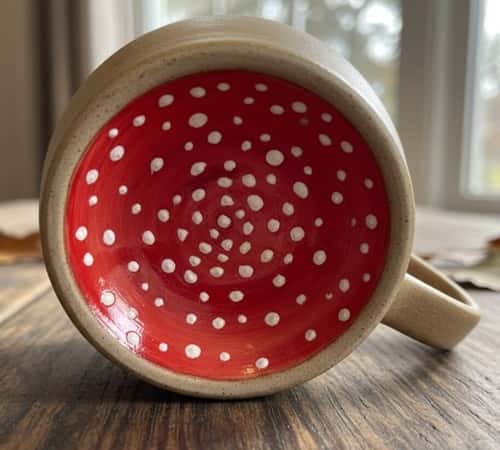
This clever handmade mug inspiration features a recessed bottom that, when the mug is right-side up, clearly shows the top of a stylized mushroom cap.
When throwing the mug on the wheel, instead of leaving the bottom flat, push the clay in a bit to create a wide, shallow indentation in the base.
This concave area is your canvas. Hand-paint a large, simple fly agaric cap design – bright red with crisp white dots – inside this sunken area, being meticulous with your underglaze application.
The rest of the mug should be a simple, natural stoneware color.
When you pick up the mug, that vibrant red mushroom cap is the first thing you see looking up into the base, a hidden gem.
This technique, using the structure for the decoration, is a hallmark of truly innovative DIY Handmade Mugs and adds a secret detail that only the user notices. It’s almost like a hidden forest floor when the mug is empty!
5. Climbing Vine and Tiny Tree Frog Scene
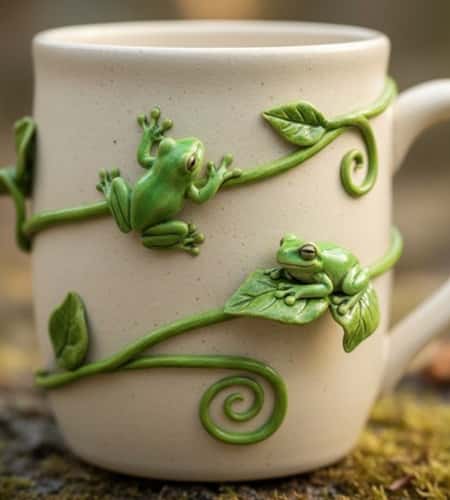
We’re combining two classic Cottagecore Handmade Mug Ideas elements here: the winding vine and the tiny frog. The key is achieving a genuine sense of movement.
Use a thin clay extruder to create very fine “vines” – about the thickness of heavy twine – and start them low on the mug, wrapping them loosely but deliberately around the mug’s body in a gentle spiral.
Then, sculpt two or three incredibly small, delicate tree frogs – the size of a dime or smaller – and attach them strategically to the vines.
One might be climbing, another resting on a tiny, attached leaf. Glaze the vines in a variegated green, transitioning from dark to light.
The little frogs should be a striking, smooth jade green or even an electric blue to contrast with the background, drawing the eye instantly to their tiny forms.
This is all about scale; the contrast between the generous size of the mug and the minuteness of the frogs and vines creates visual interest and an undeniable sense of cottagecore immersion.
6. Lichen-Patterned Textural Mug
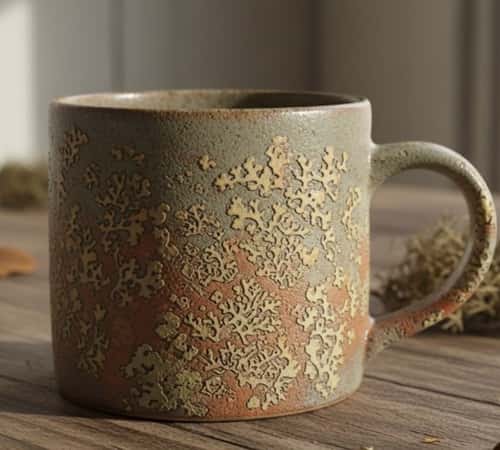
Let’s talk texture and natural patterns; this gives the search engines something new to chew on.
Lichen – that crusty, organic growth on rocks and trees – is a total cottagecore staple but rarely used in handmade mugs.
Start by coating the mug with a neutral, matte glaze. While that’s drying, mix a few small batches of different colored underglazes: a muted grey-green, a dusty orange, and a pale yellow.
Using a stiff bristle brush or a sponge piece, lightly dab and stipple these colors randomly all over the mug, overlapping and blending them to mimic the mottled, patchy look of lichen growing on stone.
Then, the unique part: using a thin ceramic sgraffito tool, scratch back through the patterned underglaze to the base clay in small, irregular circle and lobe shapes.
These lines should resemble the little cracks and edges of real lichen colonies.
The resulting texture and color work elevates the mug from simple painting to a complex textural piece, providing unique handmade mug inspiration.
It’s a very organic, earthy look that brings the quiet beauty of the forest floor right to your hand.
7. Frog-Shaped Lid with a Mushroom Handle
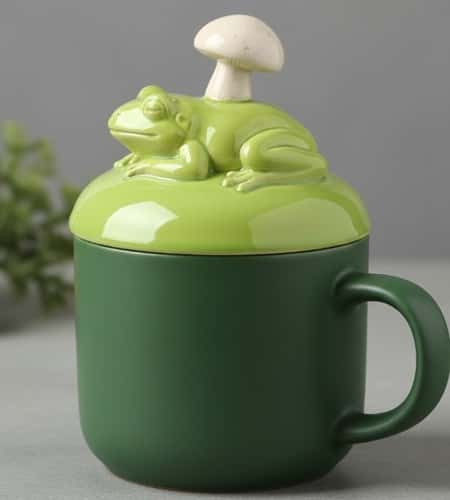
We’re introducing a lid, which turns a mug into a useful canister or teacup set – a fantastic handmade upgrade.
This design has a substantial, bowl-shaped mug and a custom-fit lid.
The unique aspect is that the entire lid is shaped like a frog that is flattened slightly, like it’s resting.
The frog’s head and upper back form the majority of the lid, complete with two subtle, bulbous eyes.
The handle for lifting the lid? That’s where the mushroom comes in.
Sculpt a small, classic capped mushroom – like a tiny button mushroom – and attach it securely right in the middle of the frog’s back.
The mug itself should be a simple, deep forest green or blue. Glaze the frog lid a shiny, contrasting lime green, and the little mushroom handle in a creamy white.
This detail is playful and functional, providing a substantial grip for removing the lid.
It’s a complete set that really speaks to the playful side of Cottagecore Handmade Mug Ideas.
8. Mushroom “Warts” Textural Mug
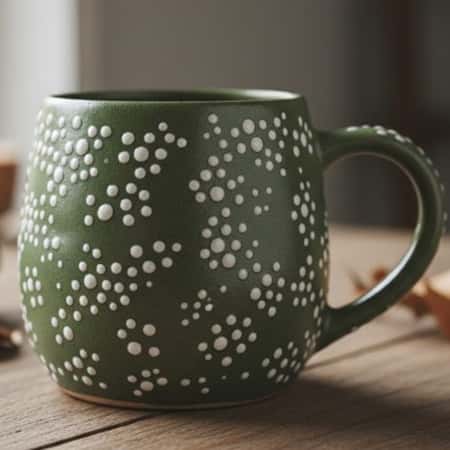
Let’s focus on the texture of the mushroom cap itself. This is another tactile design that differentiates it from simple painted mug ideas.
The whole mug is a canvas for subtle mushroom details. Start with a plain cylindrical form.
Using small, carefully rolled balls of clay – about the size of BBs or small peas – apply these to the mug’s surface in a scattered, irregular pattern, concentrating them towards the top rim.
These will represent the small warts or scales found on the caps of certain mushrooms, such as the Amanita.
After the bisque fire, glaze the mug in a dark, earthy tone – maybe a matte black or a deep olive green.
Then, for the warts, use a crisp white or a pale yellow opaque glaze, carefully painting only the tiny raised balls.
When the mug comes out of the final fire, the contrast between the smooth, dark body and the randomly textured, bright little dots is stunning.
This is a very subtle, textural approach to Cottagecore Handmade Mug that is both easy to replicate and visually striking.
9. Mud-Wallow Frog Base Relief
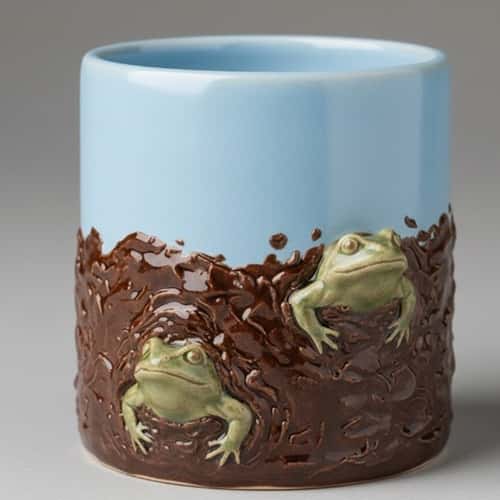
This idea focuses on the bottom section of the mug, creating a diorama effect.
Instead of attaching a frog to the handle, we’re giving it its own habitat at the foot of the mug.
Create a wide, thick relief band – maybe an inch or two tall – around the very base of the mug, sculpting it to resemble thick, earthy mud.
Embedded within this mud band, sculpt one or two small, stylized frogs looking like they are emerging or settling into a little mud puddle, their bodies slightly sunken into the clay.
This technique is called bas-relief, where the shapes are raised from the background but not fully detached.
Glaze the main body of the mug a sky blue or a light pale green.
The mud band should be a heavily textured, dark brown glaze that looks wet and deep.
The little frogs should be glazed in a matte, earthy green, helping them blend into their mud-wallow environment.
10. The Woven Basket Mushroom Mug
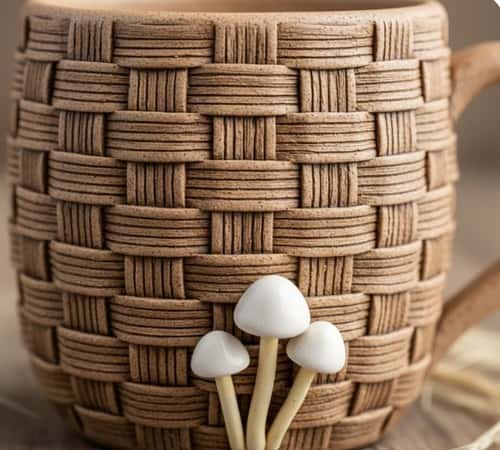
This final concept brings a whole new texture into the mix: the look of a woven basket.
This is a great skill to develop when making DIY Handmade Mugs.
Use a thin scoring tool or a needle tool to meticulously etch a criss-cross basket weave pattern into the main body of the mug while the clay is leather-hard.
This gives the illusion that the ceramic itself is a tightly woven basket.
The mushroom element here serves as an accent. Sculpt three small, slender, and slightly elongated mushrooms – like small shaggy manes or trumpets – and attach them in a tiny cluster to the lower side of the mug.
Glaze the main mug body in a natural, uncolored clear glaze over the engraved basket pattern, letting the tone of the clay dominate.
Glaze the mushroom cluster in contrasting colors – say, a matte white cap and a pale yellow stem.
The juxtaposition of the structured, woven texture with the smooth, organic mushrooms makes this a truly unique piece that stands out among standard Cottagecore Handmade Mug Ideas. It offers great handmade value.
Final Thoughts
Look, jumping into a DIY Handmade Mugs project is about more than just a craft; it’s about putting a piece of yourself, your quiet moments, into something you use every single day.
We’ve gone past the simple sticker-on-a-pot mentality, haven’t we? Focusing on techniques like bas-relief, textural lichen work, and integrating forms like the gilled Amanita base or the lily pad handle is what separates a generic ceramic piece from genuine handmade mug inspiration.
These Cottagecore Handmade Mug Ideas leverage the unique properties of clay, challenging you to think structurally about Mushrooms and Frogs, not just decoratively.
When you use your own creation, that little bit of extra effort in the detail – that mud-wallow effect or the hidden mushroom cap inset – that’s the real win. Handmade is always better because it tells a story, your story, right there on your coffee table.